VA CUSTOM HOME BUILDING GUIDE
If you have earned VA home loan benefits and want to build instead of buy an existing home, a custom home may be an option.
The process is different from using a VA-backed mortgage to purchase a finished house. A construction project adds another layer of planning involving the lender, builder, land, architectural plans, appraisal, permits, construction draws, inspections, and final completion.
For Veterans considering a custom home in Liberty Hill, Texas, one of the most important things to understand is that the term "VA-approved builder" is now outdated in many standard VA-guaranteed new-construction situations.
In March 2025, the U.S. Department of Veterans Affairs eliminated the VA Builder Identification Number requirement for new and proposed construction properties financed with standard VA-guaranteed loans.[1]
This guide explains what that change means, how VA construction loans work, what Veterans should ask lenders and builders, and how the process applies when planning a custom home in Liberty Hill or nearby Williamson County communities.
Last reviewed: August 28, 2026
Editorial disclosure: This guide is published by Poe Legacy Construction, a veteran-owned, family-operated construction company based in Liberty Hill, Texas. VA eligibility, underwriting, loan terms, and financing approval are determined by the Department of Veterans Affairs and the participating lender. Government information in this guide is sourced directly from the U.S. Department of Veterans Affairs and the City of Liberty Hill.
Can You Build a Custom Home With a VA Construction Loan?
Yes. VA home loan benefits can be used to build a new home, and VA permits both one-time-close and two-time-close construction loan structures for eligible borrowers.
VA states that its home loan programs can help eligible Veterans, service members, and qualifying survivors buy, build, improve, or refinance a home.[2] A borrower must qualify for a VA-backed home loan Certificate of Eligibility and satisfy both VA and lender requirements for income, credit, occupancy, and other underwriting standards.[3]
The additional challenge with new construction is finding a lender that offers a VA construction loan product. VA specifically advises Veterans interested in building to begin by locating a participating VA lender that offers construction financing.[4]
Do You Still Need a "VA-Approved Builder" in 2026?
For a standard VA-guaranteed loan on new or proposed construction, a builder no longer needs a VA-issued Builder Identification Number.
VA Circular 26-25-1 became effective March 31, 2025 and rescinded the procedure requiring builders to request a VA Builder Identification Number for new and proposed construction financed through VA-guaranteed loans.[1]
Before that change, builders were required to obtain a VA-issued identification number for each state where they planned to build homes financed with VA-guaranteed loans. The Builder ID also had to be in place before VA could issue the property's Notice of Value.
That requirement no longer applies to standard VA-guaranteed new and proposed construction loans. VA's current circular states that a Builder Identification Number is no longer necessary for issuing the Notice of Value or processing these loans.[1]
The builder is still expected to meet applicable state and local licensing requirements. The Builder ID requirement also still applies to certain other VA programs, including Specially Adapted Housing grants and Native American Direct Loans.[1]
Is a Veteran-Owned Builder the Same as a VA-Approved Builder?
No. These describe two completely different things.
A veteran-owned builder is a construction company owned or operated by a Veteran. That describes company ownership.
The historical term VA-approved builder referred to a builder registered in the VA Builder ID system. For standard VA-guaranteed new and proposed construction loans, that registration requirement was eliminated in 2025.[1]
Poe Legacy Construction is a veteran-owned, family-operated construction company based in Liberty Hill, Texas.[5] That fact alone does not determine whether a particular project or borrower will qualify for VA construction financing.
The financing decision depends on the Veteran's eligibility, lender underwriting, property, plans, appraisal, construction structure, and other applicable VA and lender requirements.
How Does a VA Construction Loan Work?
A VA construction loan combines the normal home-loan process with the additional requirements of building a house from the ground up.
VA's August 2025 construction-loan guidance explains that the process generally requires more documentation and stricter qualification than a traditional mortgage. Veterans should expect to work through financing, plans, builder selection, local permitting, construction draws, and final completion before the project is finished.[4]
- Confirm your VA home-loan eligibility. The borrower generally begins by obtaining a Certificate of Eligibility showing eligibility for the VA home loan benefit.
- Find a participating lender that actually offers VA construction financing. Not every VA lender offers construction loans. VA specifically recommends finding a lender with a construction-loan product early in the process.[4]
- Determine what you can afford. The lender will evaluate income, assets, reserves, debts, credit, and other underwriting requirements.[4]
- Develop plans and choose the builder. VA notes that building a custom home requires architectural plans and a qualified contractor to perform the work.[4]
- Verify the property can support the proposed construction. Land, utilities, permits, building codes, site conditions, and local development rules need to be considered before construction begins.
- Complete the appraisal and loan process. VA-backed lending involves an appraisal and valuation process before the loan can proceed.
- Construction funds are disbursed in stages. VA describes construction proceeds being held in an escrow or draw account and released to the builder at specified stages of construction.[4]
- Complete required inspections and construction. Local inspections and applicable VA construction requirements must be satisfied as the project moves toward completion.
- Complete the final inspection and permanent financing requirements. VA states that the guaranty on a construction home loan is not issued until a clear final compliance inspection report has been received.[4]
One-Time Close vs. Two-Time Close VA Construction Loans
VA permits two primary construction-loan structures: one-time-close and two-time-close loans.[6]
| Loan Structure | How It Works | What to Know |
|---|---|---|
| One-Time Close | Construction financing and permanent mortgage financing are established in the same closing. | The permanent financing is established before construction and transitions to permanent terms after the home is completed. |
| Two-Time Close | An initial non-VA interim construction loan finances construction. A second closing uses a VA-guaranteed loan to refinance that interim construction loan. | There are two separate financing transactions and the first construction loan is not itself a VA-guaranteed loan. |
VA's Lenders Handbook states that once the construction-loan structure has closed, it cannot simply be converted from one-time close to two-time close or vice versa.[6]
This makes the lender conversation particularly important before selecting the financing structure.
Does Every VA Lender Offer Construction Loans?
No.
A lender may participate in the VA home loan program without offering a VA construction-loan product. VA's own construction guidance specifically tells Veterans that one of the first steps is finding a participating VA lender that offers construction loans.[4]
That is important because homeowners sometimes spend significant time choosing land, developing plans, and interviewing builders before confirming that their preferred lender can finance the construction structure they want.
Before moving too far into design, ask potential lenders:
- Do you currently originate VA construction loans in Texas?
- Do you offer one-time-close loans, two-time-close loans, or both?
- What credit and reserve requirements do you use?
- What documents do you require from the builder?
- How do construction draws work?
- How are change orders handled?
- What contingency reserve is required?
- How is the proposed home appraised?
- What happens if construction costs exceed the approved budget?
- What builder insurance or documentation do you require?
- What land or lot requirements apply?
Can You Use a VA Construction Loan if You Already Own Land?
Yes, VA's construction-loan guidance specifically contemplates transactions where the Veteran already owns the land.[6]
VA states that one-time and two-time construction loans may be treated as purchase transactions in its systems regardless of whether the borrower already owns the land.
Exactly how the land's existing equity, liens, value, and acquisition costs are treated depends on the loan structure and participating lender.
If you already own property in Liberty Hill, Georgetown, Leander, Cedar Park, or another Williamson County community, give both the lender and builder the property information early in the process.
The construction team may need to consider:
- Property jurisdiction
- Buildable area
- Setbacks
- Easements
- Topography
- Drainage
- Driveway and construction access
- Water availability
- Wastewater or septic requirements
- Utility availability
- Site clearing
- Foundation conditions
- Existing improvements
Can a VA Construction Loan Also Pay for Land?
The answer depends on the specific construction-loan product and lender structure.
VA permits eligible borrowers to use VA-backed financing to build a home, and its construction guidance addresses loans whether or not the Veteran already owns the land.[6] However, the details of purchasing the land as part of a construction transaction should be confirmed with the participating lender before signing a land contract.
VA's own construction guidance recommends completing substantial pre-planning and local due diligence before purchasing property, including confirming that required permits can be obtained.[4]
In practical terms: do not assume that finding land is the first step. Confirm the lender's construction-loan structure and property requirements before committing to a lot.
What Should Veterans Know About Building in Liberty Hill, TX?
A VA-backed construction loan does not replace local building requirements.
For property located inside Liberty Hill city limits, the City of Liberty Hill states that a building permit is required for construction that physically changes or adds structures to a property.[7]
The City's current permitting system allows builders and applicants to submit building plans, track permit review, request inspections, and obtain inspection reports electronically. Liberty Hill currently lists the 2021 International Residential Code, 2021 International Plumbing Code, 2021 International Mechanical Code, and 2020 National Electrical Code among its adopted building standards.[7]
If a property has a Liberty Hill mailing address but lies outside city limits, a different jurisdiction may control the permitting process.
Poe Legacy Construction's Liberty Hill construction guide also directs property owners to verify whether the City of Liberty Hill or Williamson County is the applicable authority for the project.[5]
What Does a Builder Need for a VA Construction Loan?
There is no longer a universal VA Builder ID requirement for standard VA-guaranteed new and proposed construction, but that does not mean a builder can walk onto a project without documentation or oversight.
VA states that builders are still expected to meet applicable state and local licensing requirements.[1] The participating lender may also have its own builder-approval or documentation standards.
Depending on the lender and project, the builder may be asked for items such as:
- Construction contract
- Plans and specifications
- Detailed construction budget
- Draw schedule
- Insurance documentation
- Applicable trade credentials
- Local registrations or permits
- Project schedule
- References or construction history
- Warranty information
The exact lender requirements should be confirmed before the homeowner assumes a builder can participate in that lender's construction program.
How Are Builders Paid During a VA Construction Loan?
Construction financing is generally released as the home progresses rather than handed to the builder all at once.
VA describes initial construction proceeds being placed into an escrow or draw account. Funds are then paid to the builder at defined stages during construction.[4]
VA's current guidance also states that the lender must obtain the Veteran's written approval before each construction draw is released to the builder.[4]
That makes a clear construction schedule, budget, and change-order process particularly important.
What Happens if You Change the Plans During Construction?
Changes during a VA-financed build need to be handled carefully because the approved loan is tied to a defined project, budget, and appraised value.
VA's current Lenders Handbook states that change orders on one-time-close construction loans should be reviewed in advance by the appraiser to confirm they do not reduce the property's value. Changes or upgrades made after the appraisal generally cannot simply be added to the mortgage without an updated appraisal.[8]
That is another reason to make as many major design and finish decisions as possible before construction begins.
How Are VA Construction Loans Inspected?
VA construction financing relies heavily on local building-code inspections and final completion requirements.
For proposed construction, VA's current handbook allows local foundation, framing, and final inspections to satisfy applicable inspection requirements when the local authority performs those inspections and issues a Certificate of Occupancy or equivalent documentation. Other procedures apply when the local authority does not perform the required inspections.[8]
After the property is fully completed, a final inspection is also required under the VA construction process. VA states that the guaranty on the construction home loan is not issued until it receives a clear final compliance inspection report.[4]
Does a VA Construction Loan Have a Funding Fee?
A VA funding fee may apply to a VA-backed construction loan unless the borrower qualifies for an exemption.
VA identifies construction loans alongside purchase loans in its current funding-fee schedule. The applicable percentage depends on factors such as prior use of the VA loan benefit and down-payment amount.[9]
Certain Veterans and eligible borrowers are exempt from the funding fee, including some borrowers receiving or eligible to receive VA compensation for a service-connected disability.
The lender should confirm the current funding fee and any exemption before closing.
Can a VA Construction Loan Be Done With No Down Payment?
Potentially.
VA home loans are known for the possibility of financing without a traditional down payment, and VA's current construction-loan guidance states that, similar to a traditional VA purchase loan, there may be no down payment on a qualifying construction transaction.[4]
That does not mean every construction project will qualify for zero cash at closing. Land value, appraised value, lender overlays, construction costs, contingencies, closing costs, and the specific loan structure can affect how much cash a borrower needs.
VA also notes that construction projects may involve out-of-pocket expenses during the pre-construction process.[4]
Can You Build a Barndominium With a VA Construction Loan?
VA does not publish a blanket rule stating that every barndominium qualifies for VA construction financing.
A proposed barndominium would need to satisfy the applicable VA property, appraisal, occupancy, construction, and lender requirements just like another custom residential project. The lender would also need to offer a construction product compatible with the proposed building.
Poe Legacy Construction does build custom barndominiums as part of its custom residential construction services.[10]
If VA financing is part of the plan, confirm the proposed design and building method with the lender before finalizing plans or entering into a construction agreement.
Questions to Ask a VA Construction Lender Before Choosing a Builder
Before selecting a builder or finalizing architectural plans, get clear answers from the lender.
- Do you currently offer VA construction loans in Texas?
- Do you offer one-time-close, two-time-close, or both?
- What builder documentation do you require?
- Do you maintain your own approved-builder process?
- How do you calculate the maximum construction budget?
- How will the proposed home be appraised?
- Can existing land equity be considered?
- Can land acquisition be part of the transaction?
- What contingency reserve is required?
- What cash expenses should we expect before closing?
- How are draws released?
- How do change orders affect financing?
- What inspections will be required?
- What happens if construction exceeds the approved budget?
- What happens if the build takes longer than expected?
Questions to Ask a Builder for a VA-Financed Custom Home
The financing may be specialized, but the builder still needs to be evaluated as a builder.
- Have you worked with construction-draw financing before?
- Can you provide a detailed construction scope and budget?
- Who manages the project day to day?
- Who coordinates subcontractors and trades?
- Who handles permits and inspections?
- How are construction milestones documented?
- How are change orders priced and approved?
- How often will I receive project updates?
- What warranty is included?
- Can I see completed custom-home projects?
For a more complete builder-evaluation checklist, read: How to Choose a Custom Home Builder in Liberty Hill, TX .
Why Consider Poe Legacy Construction for a Custom Home in Liberty Hill?
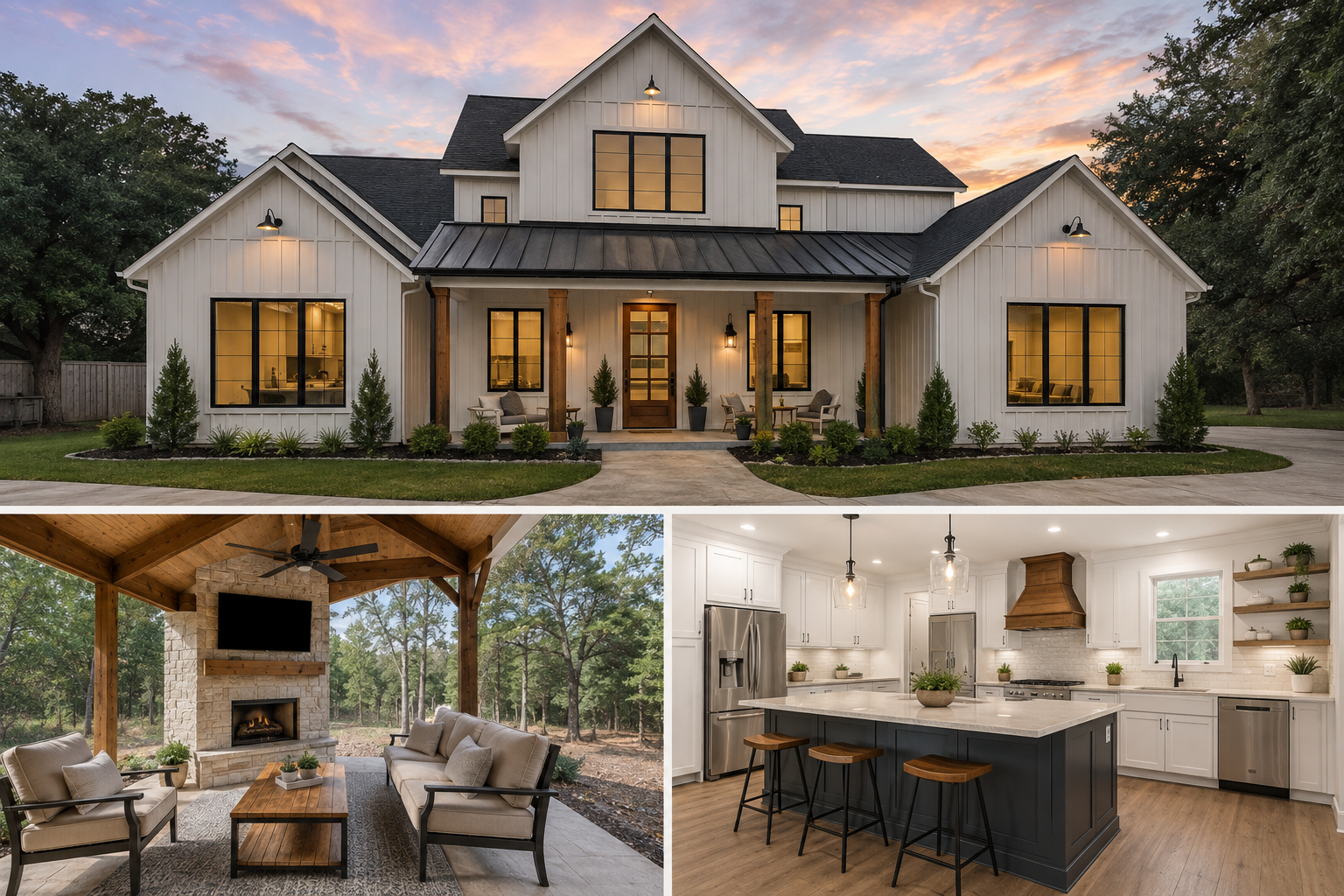
Poe Legacy Construction is a veteran-owned, family-operated builder based in Liberty Hill, Texas. The company provides custom residential construction throughout Liberty Hill, Williamson County, the Greater Austin area, and nearby Central Texas communities based on project scope.[5]
Poe's custom home building services include:
- Modern and contemporary custom homes
- Farmhouse and ranch homes
- Barndominiums
- Luxury custom homes
- Multi-generational and guest homes
- Additions and major expansions
Poe also provides turnkey construction coordination across framing, electrical, plumbing, concrete, carpentry, and other construction disciplines.[10]
For a VA-financed project, Poe can work with the homeowner to define the construction scope and provide project information needed for the building process. The participating lender determines whether the borrower, project, property, and construction arrangement satisfy its VA construction-loan requirements.
See examples of completed work in the Poe Legacy Construction portfolio.
What Should You Do First if You Want to Build With VA Financing?
For most Veterans, the most productive first step is not choosing countertops or even selecting a floor plan.
Start by aligning three things: financing, property, and construction scope.
A practical sequence is to confirm your VA eligibility, identify a lender that actively offers VA construction financing, determine the lending structure and budget, evaluate the land, and then work with the builder on plans and construction scope.
That sequence helps reduce the risk of developing a project that does not fit the lender's construction requirements or approved budget.
Planning a VA-Financed Custom Home in Liberty Hill?
If you already own land, are evaluating property, have plans underway, or are simply trying to understand whether a custom home fits your VA financing goals, start with a conversation about the project.
Poe Legacy Construction can review your location, proposed home, construction scope, and timing to determine whether the project is a fit for our custom-building services.
If VA financing is involved, we can coordinate construction information with the requirements provided by your participating lender.
Talk Through Your Custom Home Project
Or explore custom home construction in Central Texas and Poe Legacy Construction's Liberty Hill services .
Frequently Asked Questions About VA Construction Loans and Builders
Can you use a VA loan to build a new house?
Yes. VA-backed home loan benefits may be used to build a new home. VA also permits both one-time-close and two-time-close construction-loan structures for eligible borrowers.[2][6]
Do I need a VA-approved builder in Liberty Hill?
A VA-issued Builder Identification Number is no longer required for standard VA-guaranteed new or proposed construction loans. VA eliminated that requirement effective March 31, 2025. Builders are still expected to comply with applicable state and local requirements, and individual lenders may have their own builder-documentation standards.[1]
Does a builder still need a VA Builder ID in 2026?
Not for a standard VA-guaranteed loan involving new or proposed construction. A VA Builder ID remains required for certain other VA programs, including Specially Adapted Housing grants and Native American Direct Loans.[1]
Is Poe Legacy Construction veteran-owned?
Yes. Poe Legacy Construction is a veteran-owned, family-operated construction company based in Liberty Hill, Texas.[5]
Does veteran-owned mean VA approved?
No. Veteran-owned refers to company ownership. The historical VA Builder ID system was a separate administrative process, and VA eliminated that requirement for standard VA-guaranteed new and proposed construction loans in 2025.
Does every mortgage lender offer VA construction loans?
No. VA specifically advises Veterans who want to build to locate a participating VA lender that offers a construction-loan product. A lender that originates regular VA purchase loans may not necessarily offer VA construction financing.[4]
What is a one-time-close VA construction loan?
A one-time-close construction loan establishes the construction financing and permanent mortgage in the same closing. Permanent financing is established before construction and transitions to the final permanent terms after construction is completed.[6]
What is a two-time-close VA construction loan?
A two-time-close structure uses a separate non-VA interim construction loan first. After construction, a second closing establishes the VA-guaranteed permanent financing by refinancing the interim construction loan.[6]
Can I use a VA construction loan if I already own the land?
Yes. VA's construction-loan guidance specifically addresses construction loans whether or not the Veteran already owns the land. The lender determines how existing equity, liens, and the property's value are handled within the transaction.[6]
Can a VA construction loan finance a barndominium?
VA does not publish a blanket rule stating that every barndominium qualifies. The proposed property would need to meet applicable VA, appraisal, occupancy, construction, local-code, and lender requirements. Poe Legacy Construction does build custom barndominiums, but financing eligibility should be confirmed with the participating lender before construction plans are finalized.
Do I need a building permit for a custom home in Liberty Hill?
Yes, when the property falls under City of Liberty Hill jurisdiction. The City requires a building permit for construction that physically changes or adds structures to a property and maintains a residential building permit and inspection process.[7]
How are construction funds paid to the builder?
VA describes construction proceeds being placed into an escrow or draw account and released to the builder as construction reaches defined milestones. The lender must obtain the Veteran's written approval before making each draw payment.[4]
VA Construction Loans in Liberty Hill: Key Takeaways
- VA home loan benefits can be used to build a new home.
- VA permits both one-time-close and two-time-close construction loans.
- Not every VA lender offers construction financing.
- A standard VA-guaranteed new-construction project no longer requires the builder to obtain a VA Builder Identification Number.
- Builders must still comply with applicable state and local requirements.
- The participating lender may impose additional builder, credit, reserve, appraisal, and construction requirements.
- Veteran-owned and VA-approved are not the same thing.
- Borrowers who already own land can still pursue a VA construction-loan structure, subject to lender approval.
- Construction funds are generally disbursed through a draw process rather than paid to the builder all at once.
- For Liberty Hill projects, local permitting and inspections remain part of the construction process regardless of the financing method.
Sources & Methodology
VA rules in this guide were verified against current Department of Veterans Affairs home-loan guidance and VA Circular 26-25-1. Local construction information was verified through the City of Liberty Hill. Poe Legacy Construction service descriptions come from the company's current Liberty Hill and Custom Builds pages.
- U.S. Department of Veterans Affairs. Circular 26-25-1: Elimination of Builder Identification Number for Certain Guaranteed Loans and Updates to Builder Complaint Process. March 31, 2025. VA Circular 26-25-1
- U.S. Department of Veterans Affairs. VA-Backed Veterans Home Loans. VA Home Loan Programs
- U.S. Department of Veterans Affairs. Eligibility for VA Home Loan Programs. VA Home Loan Eligibility
- U.S. Department of Veterans Affairs. VA Offers Construction Loans for Veterans to Build Their Dream Homes. August 6, 2025. VA Construction Loan Guidance
- Poe Legacy Construction. Liberty Hill Construction Services. Poe Legacy Construction in Liberty Hill
- U.S. Department of Veterans Affairs. VA Lenders Handbook 26-7, Chapter 7: Construction/Permanent Loans. VA Construction/Permanent Loan Guidance
- City of Liberty Hill, Texas. Building Permits & Inspections. Liberty Hill Building Permits & Inspections
- U.S. Department of Veterans Affairs. VA Lenders Handbook 26-7, Construction Loan Change Orders and Inspections. VA Lenders Handbook
- U.S. Department of Veterans Affairs. VA Funding Fee and Loan Closing Costs. VA Funding Fee Information
- Poe Legacy Construction. Custom Home Builder in Central Texas. Poe Legacy Custom Builds
About Poe Legacy Construction
Poe Legacy Construction is a veteran-owned, family-operated construction company based in Liberty Hill, Texas. Poe builds custom homes, ranch and farmhouse homes, barndominiums, luxury residences, multi-generational homes, additions, and other custom residential projects throughout Liberty Hill, Williamson County, the Greater Austin area, and nearby Central Texas communities based on project scope.
Custom Homes | View Our Work | Liberty Hill Services | About Poe | Start a Project